Wulfenite
Wulfenite
PbMoO₄ Properties
- Category
- Mineral
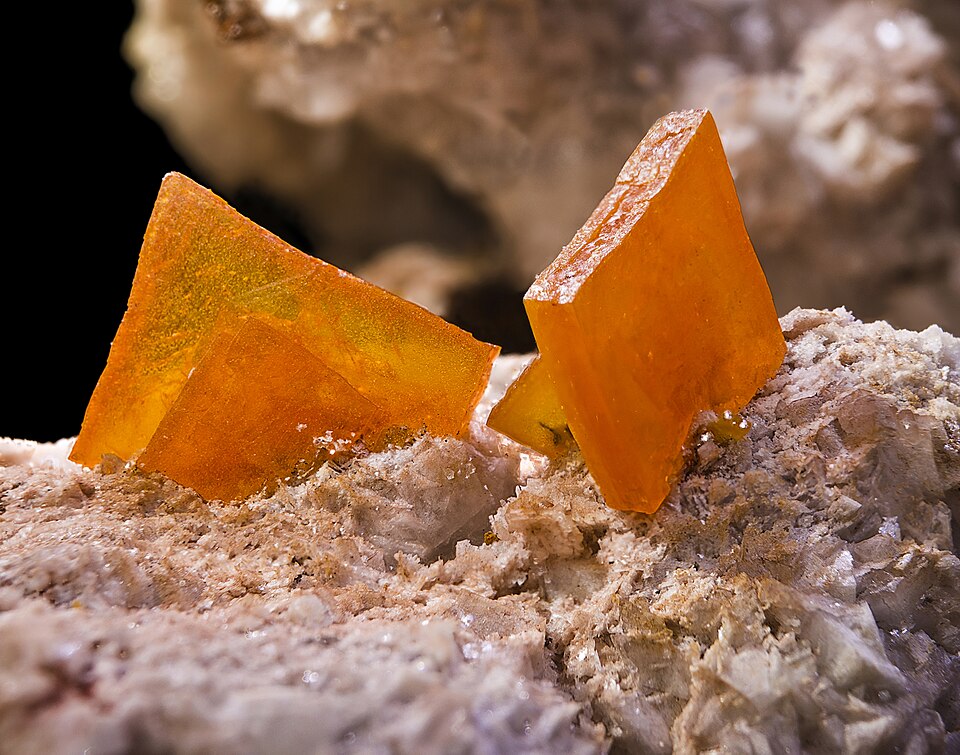
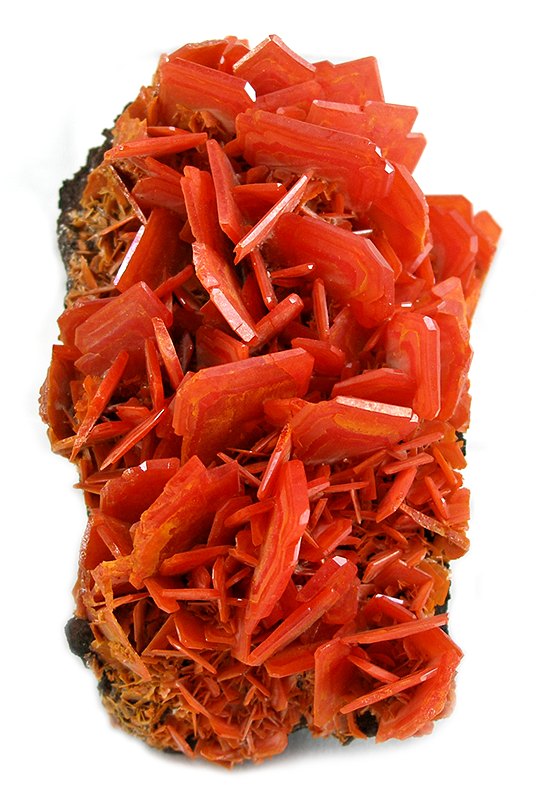
Wulfenite is a lead and molybdenum mineral that forms tetragonal crystals of extraordinary beauty, often yellow-orange or deep red in color, appreciated by collectors for the rarity and geometric elegance of its tabular crystals.
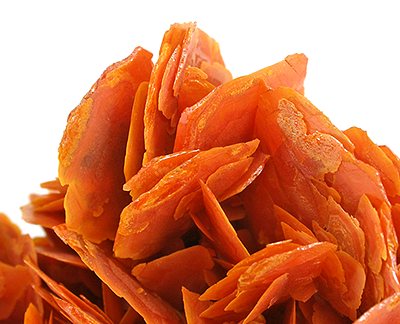
Wulfenite (PbMoO₄) is a secondary mineral that forms in oxidation zones of lead and molybdenum deposits, where percolating waters alter primary sulfides. Its tabular crystals, sometimes very thin and nearly transparent, display perfect tetragonal symmetry and frequently develop characteristic pyramidal faces. The color ranges from lemon yellow to vermilion red, with intermediate orange hues; this color variability depends on trace elements such as chromium and vanadium that substitute for molybdenum in the structure.
From a collector's perspective, wulfenite represents one of the most sought-after minerals in the world. The most celebrated deposits are found in Arizona (United States), particularly in the Red Cloud mine, where museum-quality crystals of exceptional size are recovered. Other prized localities include Namibia, Mexico, and China. Its fragility (hardness 2.75-3 on the Mohs scale) and tendency to chip require careful conservation, but this does not diminish the appeal it holds for mineralogists and enthusiasts.
Wulfenite crystallizes in the tetragonal system, space group I4/mmm, with lattice parameters a = 5.43 Å and c = 12.00 Å. The structure consists of isolated MoO₄ tetrahedra linked to PbO₈ polyhedra in distorted octahedral coordination, forming a stable three-dimensional lattice. The calculated density is 6.8-7.0 g/cm³.
The hardness of 2.75-3 Mohs reflects relatively weak ionic bonding; cleavage is perfect along the 110 plane, facilitating fracture along preferred crystallographic directions. The refractive index is high (nω ≈ 2.40, nε ≈ 2.28), imparting a characteristic adamantine luster. The absorption spectrum shows bands in the visible region attributable to d-d transitions of molybdenum and inclusions of chromophoric elements (Cr³⁺, V⁴⁺). Fluorescence under UV radiation is generally absent or very weak.
Quantitative chemical analysis typically reveals: PbO 55-60%, MoO₃ 40-45%, with traces of CaO, SiO₂, and minor elements. Wulfenite is soluble in dilute acids (HCl, HNO₃) and insoluble in water. Common mineral associations include cerussite, anglesite, molybdenite, limonite, and quartz.
Mining localities
- Red Cloud Mine, Gila County, Arizona, Stati Uniti
- Tsumeb, Namibia
- Sonora, Messico
- Hunan, Cina
- Carinthia, Austria
- Sardegna, Italia
Frequently Asked Questions
Where is wulfenite found and in which locations is it most common?
Wulfenite is found primarily in oxidized lead deposits, with the finest specimens coming from Arizona (USA), Mexico, and Morocco. The most celebrated localities for museum-quality crystals are Red Cloud Mine in Arizona and Touissit in Morocco, where tabular crystals reach exceptional sizes and intense colorations.
How do you recognize wulfenite from other yellow and orange minerals?
Wulfenite is recognizable by its tetragonal tabular crystals with square form and yellow-orange to intense red color, often transparent or translucent with vitreous luster. Its very high density (6.8 g/cm³), chemical formula PbMoO₄, and the hydrochloric acid test (producing white MoO₃ precipitate) easily distinguish it from similar minerals like wavellite or smithsonite.
What is the price of wulfenite and what factors determine its value?
Wulfenite prices vary enormously based on size, crystal quality, transparency, and origin: small ordinary-quality specimens cost €10-50, while well-formed and transparent crystals of 2-5 cm reach €100-500. Museum-quality specimens from famous localities like Touissit or Red Cloud can exceed €1000 depending on geometric perfection and color intensity.
How does wulfenite form and in which geological environment does it develop?
Wulfenite (PbMoO₄) forms in the oxidation zone (supergene zone) of primary lead and molybdenum deposits, when molybdate-rich solutions alter pre-existing lead minerals. It crystallizes in secondary environments at low temperatures, often associated with cerussite, anglesite, and other lead oxides, in calcareous rocks or skarns where molybdenum concentrations from oxidized primary sulfides are present.
Entry generated with Claude API (Anthropic) on data extracted from Mindat, RRUFF and Wikipedia. Not yet reviewed by a human expert. Verify data against original sources before citing in formal work.