Variscite
Variscite
AlPO₄·2H₂O Properties
- Category
- Mineral
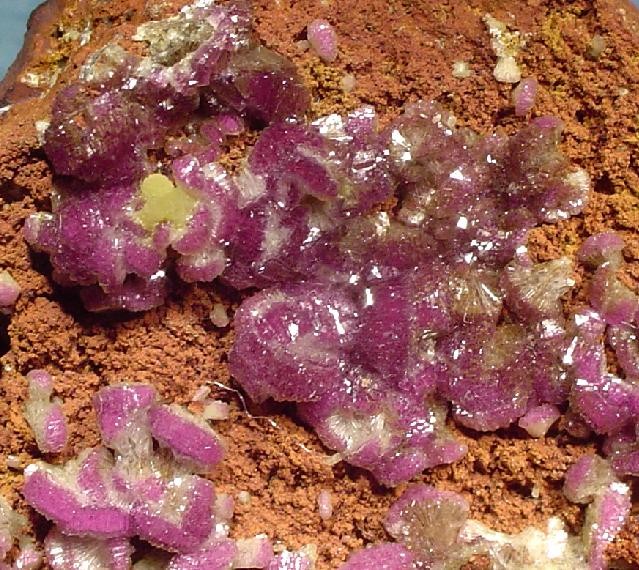
Variscite is a hydrated aluminum phosphate that forms orthorhombic crystals ranging in color from pale green to intense green, often confused with turquoise but softer and less dense. It forms in weathering environments of aluminum-rich rocks, particularly in the oxidation zones of phosphatic deposits.
Variscite is a hydrated aluminum phosphate belonging to the secondary phosphate group, with formula AlPO₄·2H₂O. It crystallizes in the orthorhombic system, forming nodular, crusty aggregates or well-developed crystals with colors ranging from pale green to intense green-blue, sometimes with yellowish tones due to iron impurities. Its moderate hardness (3.5–4.5 on the Mohs scale) and relatively low density (2.40–2.57 g/cm³) distinguish it from turquoise, with which it is frequently confused in gemological markets.
It forms predominantly in superficial weathering environments, where phosphorus and aluminum-rich solutions percolate through sedimentary and metamorphic rocks. Typical mineralogical associations include quartz, altered feldspars, limonite, and other secondary phosphates such as wavellite. The most important deposits are found in Arkansas (USA), where variscite constitutes significant nodules in Cretaceous phosphatic deposits, as well as in Australia, Germany, and Brazil. Historically appreciated as an ornamental gem by pre-Columbian peoples, variscite maintains collector and gemological interest, although its fragility and tendency to dehydrate over time require careful conservation.
Variscite: AlPO₄·2H₂O. Orthorhombic crystal system, space group Pmn2₁ (no. 31). Cell parameters: a = 9.73 Å, b = 8.64 Å, c = 4.69 Å. Mohs hardness 3.5–4.5; density 2.40–2.57 g/cm³; ordinary refractive index (nα) approximately 1.563, extraordinary (nγ) approximately 1.594; birefringence δ ≈ 0.031. Imperfect cleavage along plane 010. Color pale green to intense green-blue, sometimes with yellow tints; vitreous luster; transparent to translucent. Soluble in dilute acids. Thermogravimetric analysis reveals loss of crystallization water at temperatures above 100 °C, with complete dehydration around 250 °C. Infrared spectroscopy shows characteristic absorption bands around 3300 cm⁻¹ (O-H), 1200–1000 cm⁻¹ (P-O stretching), and 600–400 cm⁻¹ (P-O bending). Fluorescence under UV radiation is generally absent. X-ray diffractometric analysis permits distinction from turquoise (tetragonal system, CuAl₆(PO₄)₄(OH)₈·4H₂O) and wavellite (Al₃(PO₄)(OH,F)₈·5H₂O, triclinic system). Primary deposits in Cretaceous phosphatic rocks; secondary associations include quartz, altered feldspar, limonite, millisite, wavellite, and turquoise.
Mining localities
- Lucin, Utah, USA
- Garfield County, Utah, USA
- Hot Springs County, Wyoming, USA
- Harding County, South Dakota, USA
- Pike County, Arkansas, USA
- Mulga Downs, Western Australia, Australia
- Waldviertel, Austria
- Saxony, Germany
- Minas Gerais, Brazil
Frequently Asked Questions
How do you distinguish variscite from turquoise?
Variscite is softer than turquoise (hardness 4-4.5 versus 5-6) and less dense, with an orthorhombic crystal structure compared to turquoise's triclinic form. A simple hardness test with a coin or knife shows the difference immediately: variscite scratches more easily and has a lower specific gravity (2.5-2.6 versus 2.8-2.9 for turquoise).
Where is variscite found in the world?
The main variscite deposits are located in the United States (Utah and Nevada), Germany, France, and Australia, always associated with weathering zones in aluminum-rich rocks. Formation occurs in near-surface oxidation processes where aluminum combines with phosphate in waters rich in these elements.
What are the chemical properties of variscite?
Variscite is a hydrated aluminum phosphate with the formula AlPO₄·2H₂O, formed in low-temperature oxidizing environments near Earth's surface. Its orthorhombic crystal structure contains two water molecules of crystallization, making it relatively brittle and sensitive to dehydration over time.
What is the price of variscite and how should it be stored?
High-quality gem variscite typically costs 5-30 euros per carat depending on color saturation and transparency, while rough collector specimens vary greatly by size. Store it away from prolonged direct sunlight and very dry environments, as water loss can cause cloudiness and cracking; protect it from impacts given its low hardness.
Entry generated with Claude API (Anthropic) on data extracted from Mindat, RRUFF and Wikipedia. Not yet reviewed by a human expert. Verify data against original sources before citing in formal work.