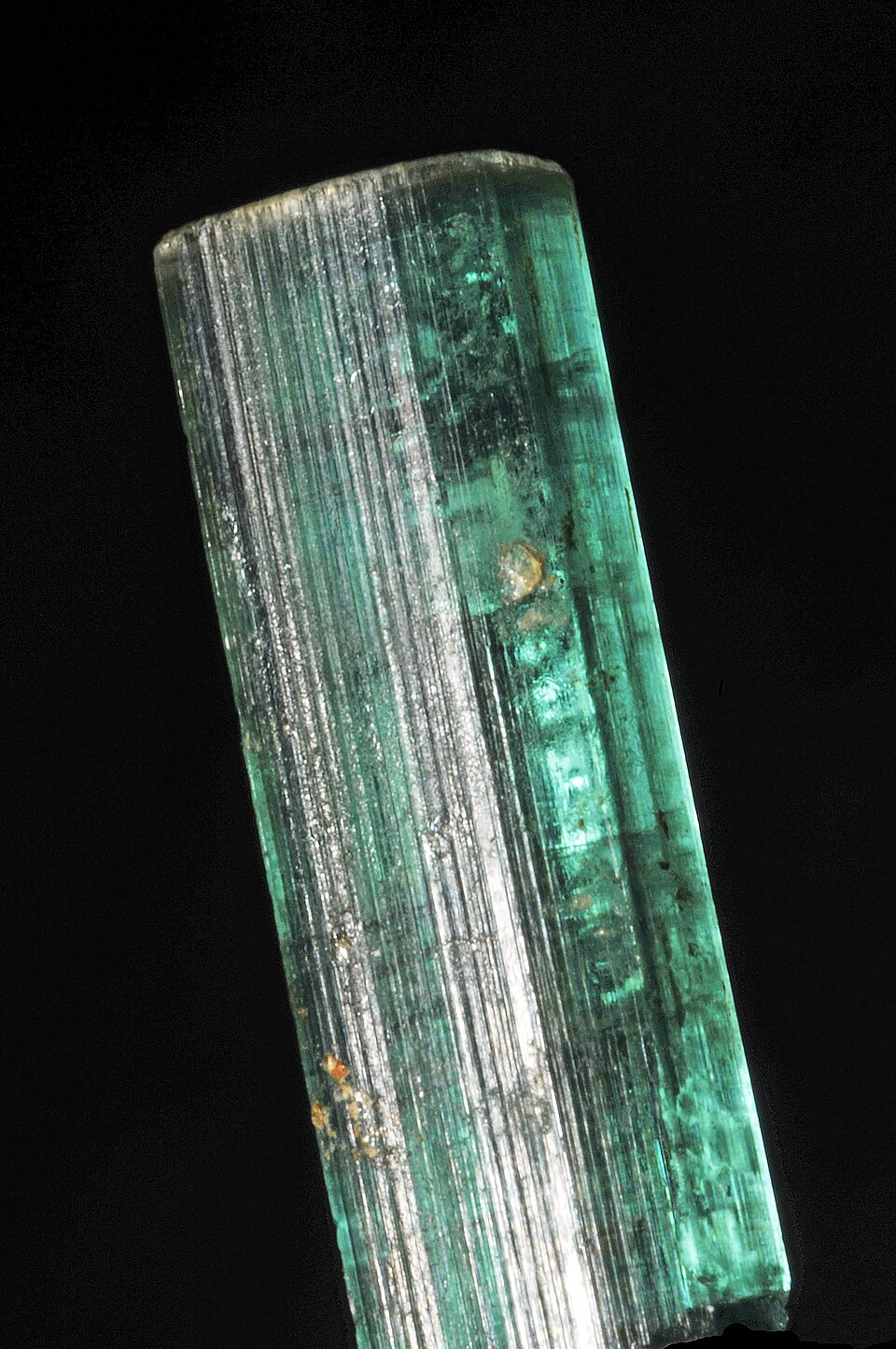
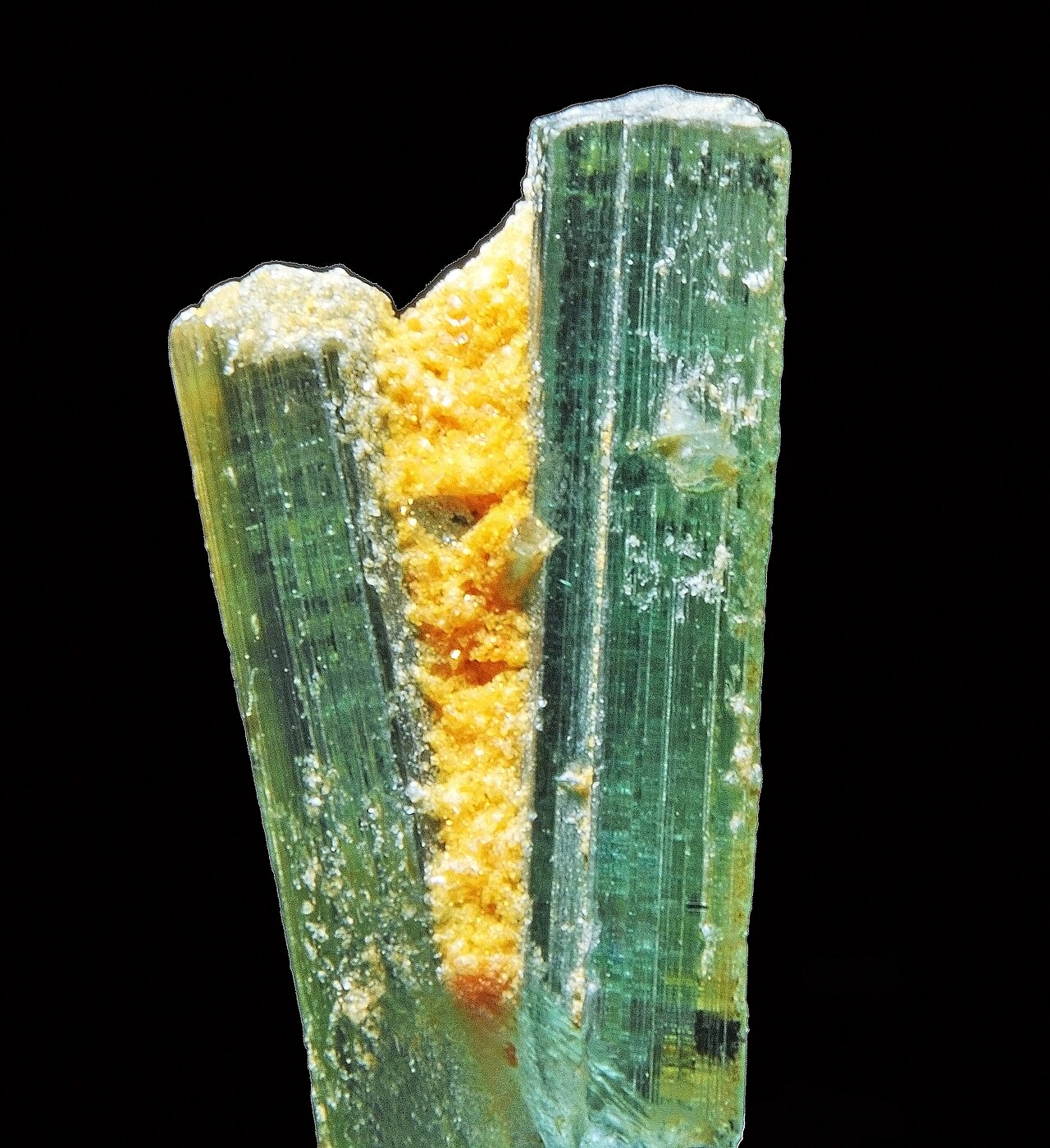
Paraíba Tourmaline
Tormalina Paraíba
Na(Li,Al)₃Al₆(BO₃)₃Si₆O₁₈(OH)₄ Properties
- Color
- Neon blue, turquoise-green
- Luster
- Vitreous
- Density
- 3.06 g/cm³
- Category
- Gem
Paraíba tourmaline is a variety of cupriferous elbaite discovered in 1989 in the Brazilian state of Paraíba, renowned for its unique neon blue-turquoise color — produced by the presence of copper in the crystal lattice.
It belongs to the tourmaline supergroup, a family of over 30 mineral species that also includes schorl, dravite, and liddicoatite. Paraíba is a trade variety of elbaite, the most lithium-rich species in the group.
The extraordinary color derives from the presence of copper (Cu²⁺) in the crystal lattice. Tourmalines normally owe their colors to iron, manganese, or chromium. Copper creates an internal luminescence effect that gemologists describe as "neon": the stone appears to emit its own light even in low illumination.
The discovery is credited to Heitor Dimas Barbosa, who excavated for years in the hills of São José da Batalha. In 1989, his perseverance was rewarded with finds that revolutionized the global gem market.
Worth noting: elbaite — the mineral species of which Paraíba is a variety — takes its name from the Island of Elba, off the Tuscan coast of Italy, where it was first described in 1913 by American mineralogist Charles Palache. A quiet connection between Tuscany and the world's most coveted gemstone.
Belongs to the tourmaline supergroup, elbaite series. Formula: Na(Li,Al)₃Al₆(BO₃)₃Si₆O₁₈(OH)₄, with partial substitution of Al by Cu and Mn at octahedral sites. Trigonal system, space group R3m. Refractive index 1.619–1.641, birefringence 0.018–0.022. Characteristic inclusions include growth channels parallel to the c-axis and two-phase fluid inclusions. Geographic origin determination requires LA-ICP-MS analysis to quantify Cu, Zn, Ga, Sr, Sn, and Pb.
Mining localities
- São José da Batalha, Paraíba, Brazil
- Rio Grande do Norte, Brazil
- Merelani Hills, Mozambique
- Nigeria
Frequently Asked Questions
What is the price of Paraíba tourmaline and why is it so expensive?
Paraíba tourmaline ranks among the world's most expensive gems, with prices from $5,000 to $50,000 per carat depending on quality. The cost reflects extreme rarity, exceptionally high collector demand, and the copper-driven neon color found nowhere else in nature.
How can I tell genuine Paraíba tourmaline from imitations?
Genuine Paraíba shows a saturated blue-turquoise color consistent from all angles. Certificates from recognized labs (GRS, IGI) are essential — synthetic versions and chemically treated blue tourmalines exist that closely imitate the appearance.
What connects Paraíba tourmaline to the Island of Elba?
Paraíba is a variety of elbaite — a mineral species named after the Island of Elba, Italy, where it was first described in 1913 by mineralogist Charles Palache. A direct thread between Tuscany and the world's most expensive mineral.
Where is Paraíba tourmaline found and is it still mined?
It is found in the Brazilian state of Paraíba (original 1989 discovery), Rio Grande do Norte, Mozambique, and Nigeria. Brazilian stones are considered the finest for color intensity. Mining continues but in very limited quantities.
Entry generated with Claude API (Anthropic) on data extracted from Mindat, RRUFF and Wikipedia. Not yet reviewed by a human expert. Verify data against original sources before citing in formal work.