Agate
Agata
SiO₂ Properties
- Category
- Gem
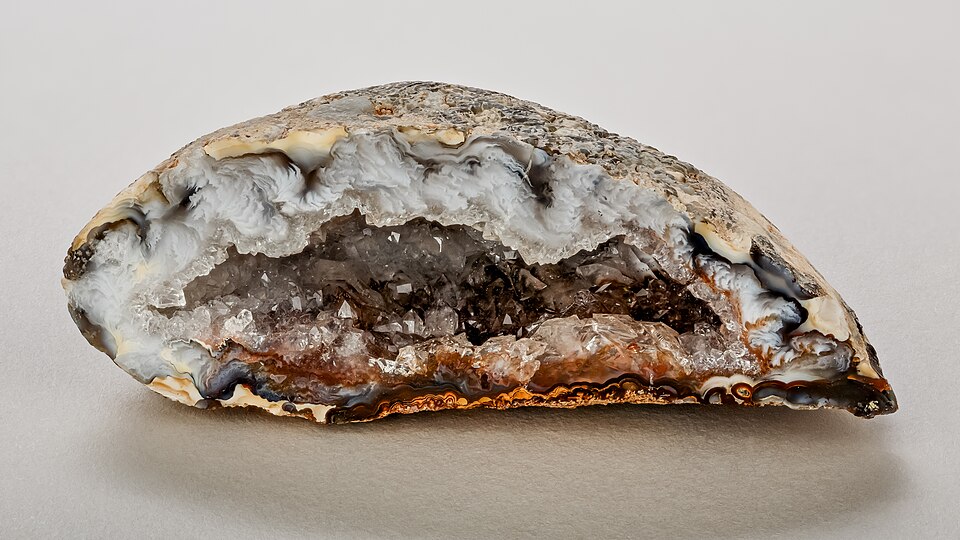
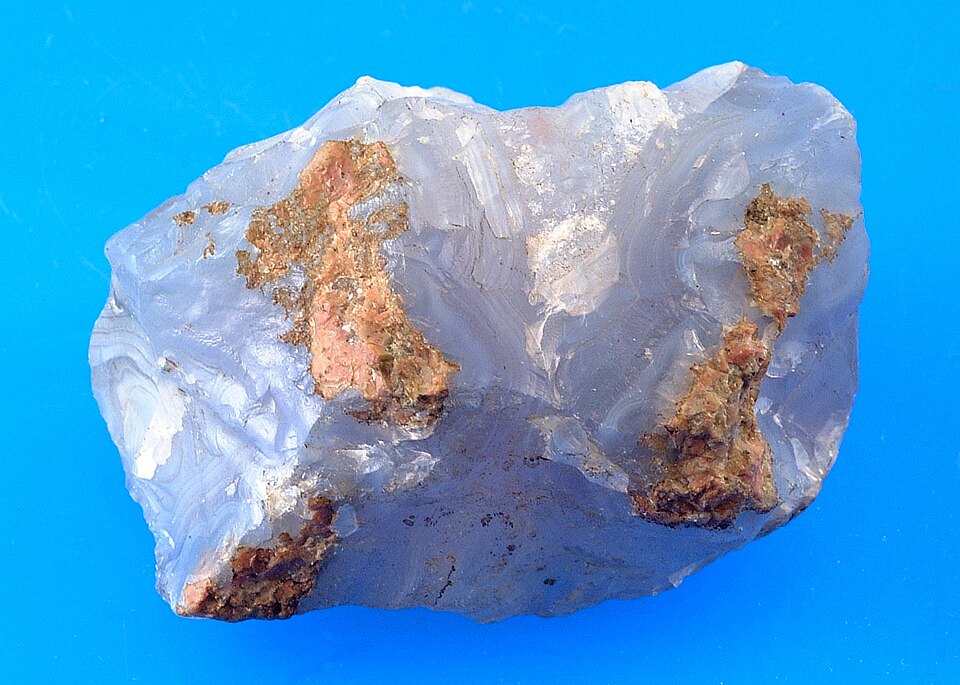
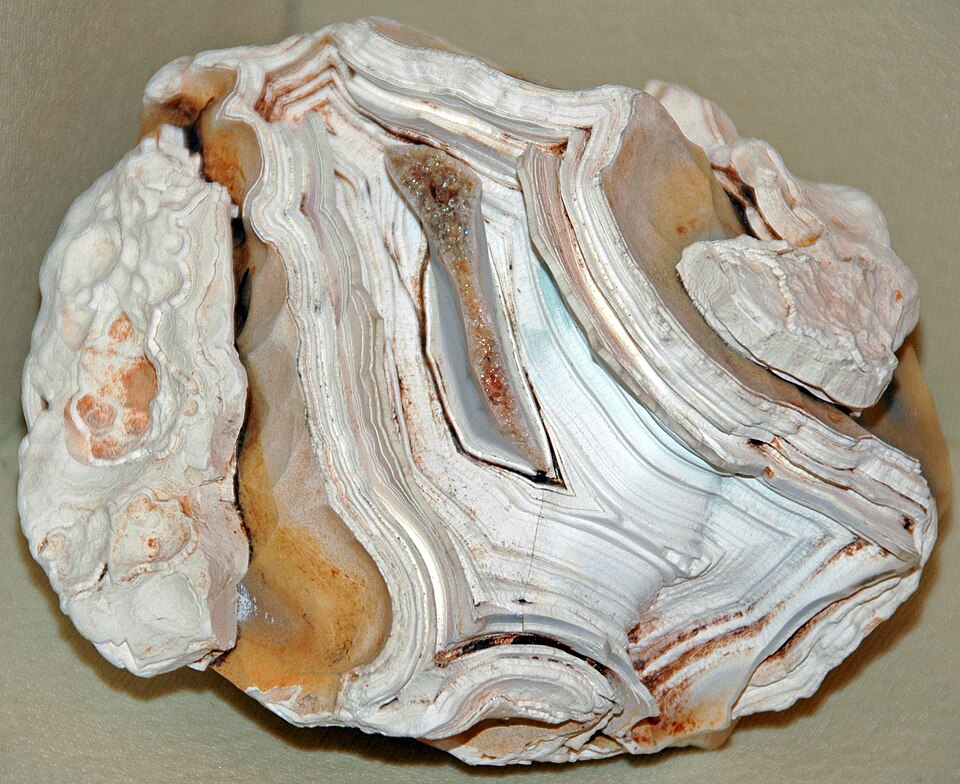
Agate is a microcrystalline variety of quartz (SiO₂) characterized by parallel colored bands and extraordinary hardness, making it ideal for jewelry and decorative objects for millennia.
Agate is a *microcrystalline* variety of quartz that forms in volcanic and sedimentary environments, where siliceous solutions percolate slowly through rock cavities, depositing extremely thin layers of silica. Its renowned *banding* derives from periodic variations in chemical composition and crystal size during crystallization. Each layer can contain traces of metal oxides—iron for reds and browns, manganese for purples, nickel for greens—which impart its extraordinary chromatic range. Its hardness of 6.5–7 on the Mohs scale makes it resistant to daily abrasion, while *translucency* varies from nearly opaque to semi-transparent depending on thickness and crystal purity. Historically, agate was already worked by the Assyrians in the 7th century B.C. for seals and amulets; in medieval Europe it remained a stone of great prestige. Today the most important deposits are found in Brazil (especially in Rio Grande do Sul state), Uruguay, Madagascar, and India, where Idar-Oberstein (Germany) remains the world center for cutting and polishing.
Agate belongs to the *trigonal* crystal system with quartz crystalline structure (space group P3₁21 or P3₂21). The chemical formula is pure SiO₂, although inclusions of iron oxides (hematite, limonite) and other trace elements are responsible for coloration. The *refractive index* is 1.530–1.540 (ordinary) and 1.539–1.549 (extraordinary), with *birefringence* of approximately 0.009. Relative density varies between 2.58 and 2.64 g/cm³. Mohs hardness is 6.5–7; *cleavage* is absent, but fracture is *conchoidal*. Under optical microscopy, the characteristic *fibrous* or *granular* structure of microcrystalline varieties is observed, with α-quartz crystals smaller than 1 μm. Under ultraviolet light (UV-A and UV-C), many agates exhibit weak to moderate *fluorescence*, often blue-violet in color. Raman spectroscopy reveals characteristic quartz bands at 206, 264, 355, 465, 695, 798, and 1161 cm⁻¹. Untreated natural agates are thermally stable up to approximately 250 °C; controlled heating can intensify or modify coloration. Many commercial specimens undergo *dyeing* with iron solutions (for reds/browns) or other organic colorants; such treatments are detectable through UV-Vis analysis and fluorescence microscopy.
Mining localities
- Rio Grande do Sul, Brasile
- Dipartimento di Artigas, Uruguay
- Madagascar
- Idar-Oberstein, Germania
- Deccan Plateau, India
- Sicilia, Italia (agate blu e dendritiche)
Frequently Asked Questions
How is agate formed and where is it found in nature?
Agate forms inside volcanic cavities when silica-rich solutions deposit slowly in successive layers, creating the characteristic colored bands. It is found mainly in volcanic and sedimentary rocks worldwide, with major deposits in Brazil, Uruguay, Madagascar, and various European regions such as Germany.
What is the hardness of agate and how do you distinguish it from other quartz varieties?
Agate has a hardness of 6.5-7 on the Mohs scale, making it resistant enough to scratching for jewelry use. It is distinguished from other quartz varieties mainly by its parallel colored bands and translucency, while common quartz is generally more homogeneous and crystalline; additionally, agate has a slightly higher density (2.58-2.64 g/cm³).
What are the main varieties of agate and how do colors vary?
The most common varieties include banded agate, moss agate (with manganese oxide inclusions that simulate moss), eye agate (with concentric circles), and fire agate (translucent orange-red). Colors depend mainly on the chemical composition of impurities trapped during formation: iron oxides create red and brown bands, manganese produces black and blue, while other element traces generate greens, yellows, and pinks.
How much does agate cost and how do prices vary?
The price of agate varies considerably based on quality, size, rarity of the variety, and level of craftsmanship, ranging from a few euros for small raw specimens to several hundred euros for high-quality cut and polished stones. The rarer and more colorful varieties, such as fire agate or certain natural blue agate specimens, command higher prices, while common untreated agates remain inexpensive and accessible to collectors and enthusiasts.
Entry generated with Claude API (Anthropic) on data extracted from Mindat, RRUFF and Wikipedia. Not yet reviewed by a human expert. Verify data against original sources before citing in formal work.