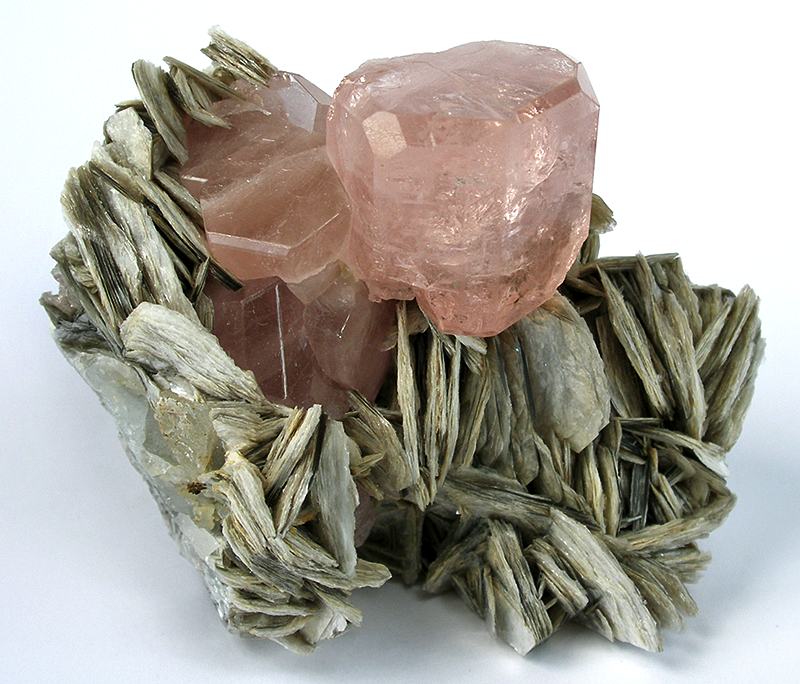
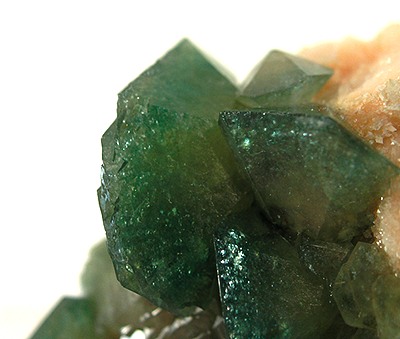
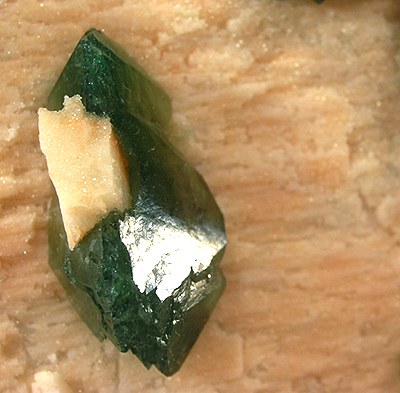
Fluorapatite
Fluorapatite
Ca₅(PO₄)₃F Properties
- Category
- Mineral
Fluorapatite is a calcium phosphate with fluorine that constitutes the primary inorganic component of dental enamel and bones, forming in magmatic, pegmatitic, and sedimentary environments. It crystallizes in the hexagonal crystal system with a hardness of 5 on the Mohs scale, distinguished by the presence of fluorine ions that make it more stable compared to other apatite varieties.
Fluorapatite is the most common member of the apatite series, a group of phosphates that also includes chlorapatite and hydroxyapatite. Its formula Ca₅(PO₄)₃F reflects a hexagonal crystal structure where calcium ions occupy two distinct crystallographic sites, while phosphate groups form the supporting structure and fluorine ions are positioned in the axial channels. This structural arrangement confers on fluorapatite remarkable thermal and chemical stability, making it particularly resistant to alteration.
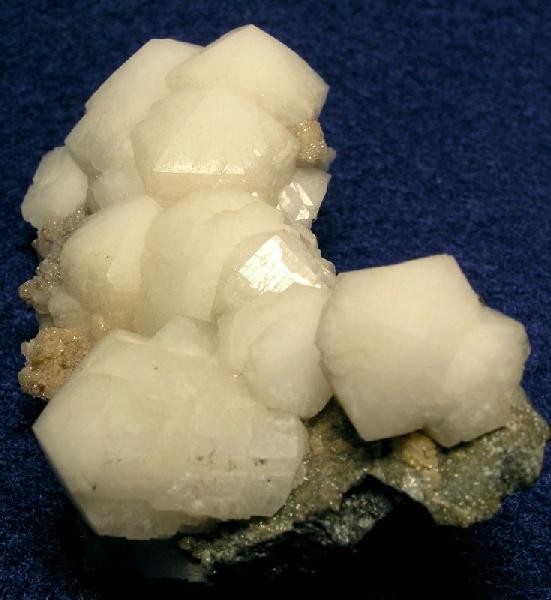
Fluorapatite forms in an extraordinary variety of geological environments: in granitic pegmatites as a primary accessory phase, in alkaline igneous rocks, in biochemical sedimentary phosphate deposits, and even in some hydrothermal environments. Biologically, it is the principal mineral constituent of dental enamel (96% by weight) and the inorganic phase of bones, where its chemical stability is fundamental for protecting teeth from acidity. Fluorapatite crystals are often colorless or slightly colored (yellow, green, blue) due to trace elements such as manganese or iron, and can reach significant sizes in high-quality pegmatites.
Fluorapatite — Ca₅(PO₄)₃F; apatite group, primary phosphates. Crystal system: hexagonal, space group P63/m, lattice parameters a ≈ 9.37 Å, c ≈ 6.88 Å. Mohs hardness: 5. Density: 3.15–3.20 g/cm³. Cleavage: absent; fracture: conchoidal. Luster: vitreous. Color: colorless, white, yellow, green, blue (due to trace element inclusions). Transparency: transparent to translucent. Refractive index: nω ≈ 1.602–1.607, nε ≈ 1.633–1.638 (birefringent, uniaxial positive). Dispersion: moderate. Pleochroism: weak or absent. Raman spectroscopy: characteristic phosphate bands around 960 cm⁻¹ (PO₄ stretching), 1050 cm⁻¹ (asymmetric stretching). IR spectroscopy: intense absorptions at 1090–1020 cm⁻¹ (PO₄³⁻), 600–500 cm⁻¹ (PO₄ bending). UV fluorescence: generally inert, occasionally weakly fluorescent in blue-green. Thermal analysis: stable up to 1200 °C; decomposition begins above this temperature. Solubility: insoluble in water; slightly soluble in dilute acids. Common mineral associations: alkali feldspars, quartz, mica, beryl, tourmaline (in pegmatites); with green apatite, monazite, xenotime (in alkaline igneous rocks); with calcite, dolomite, silica (in phosphatic sediments).
Mining localities
- Ehrenfriedersdorf, Sassonia, Germania
- Pegmatiti di Minas Gerais, Brasile
- Khibiny, Penisola di Kola, Russia
- Fosfatiere del Marocco
- Pegmatiti del Trentino-Alto Adige, Italia
- Naipes, Spagna
- Kuusamo, Finlandia
- Pegmatiti della Carolina del Nord, USA
Frequently Asked Questions
What is fluorapatite and where is it found in nature?
Fluorapatite (Ca₅(PO₄)₃F) is a calcium phosphate mineral containing fluorine that represents the primary inorganic component of tooth enamel and bones in vertebrate organisms. It forms naturally in magmatic, pegmatitic, and sedimentary environments, crystallizing in the hexagonal system and being easily identifiable due to its Mohs hardness of 5.
How do you identify fluorapatite from its crystals?
Fluorapatite can be identified by its hexagonal prismatic crystals, often transparent or translucent, ranging in color from colorless to yellow, green, or violet depending on impurities present. It exhibits a vitreous luster, subconchoidal fracture, and a density of approximately 3.2 g/cm³, properties that distinguish it from other phosphate minerals.
What is the role of fluorapatite in the human body?
Fluorapatite constitutes approximately 96% of the mineral structure of tooth enamel and about 70% of human bone, giving them mechanical strength and durability. Its chemical stability and the presence of fluorine make it more resistant to acid attack, making it naturally more protective than fluorine-free hydroxyapatite.
Where can you find and buy fluorapatite as a mineralogical specimen?
Fluorapatite can be purchased from mineralogy shops, museums with sellable collections, and online suppliers specializing in mineral specimens, with prices ranging from 10 to 100 euros depending on the quality, size, and origin of the crystal. The finest specimens come from Brazil, Spain (Bussaco), Canada, and China, where they are found in pegmatitic rocks and phosphate deposits.
Entry generated with Claude API (Anthropic) on data extracted from Mindat, RRUFF and Wikipedia. Not yet reviewed by a human expert. Verify data against original sources before citing in formal work.