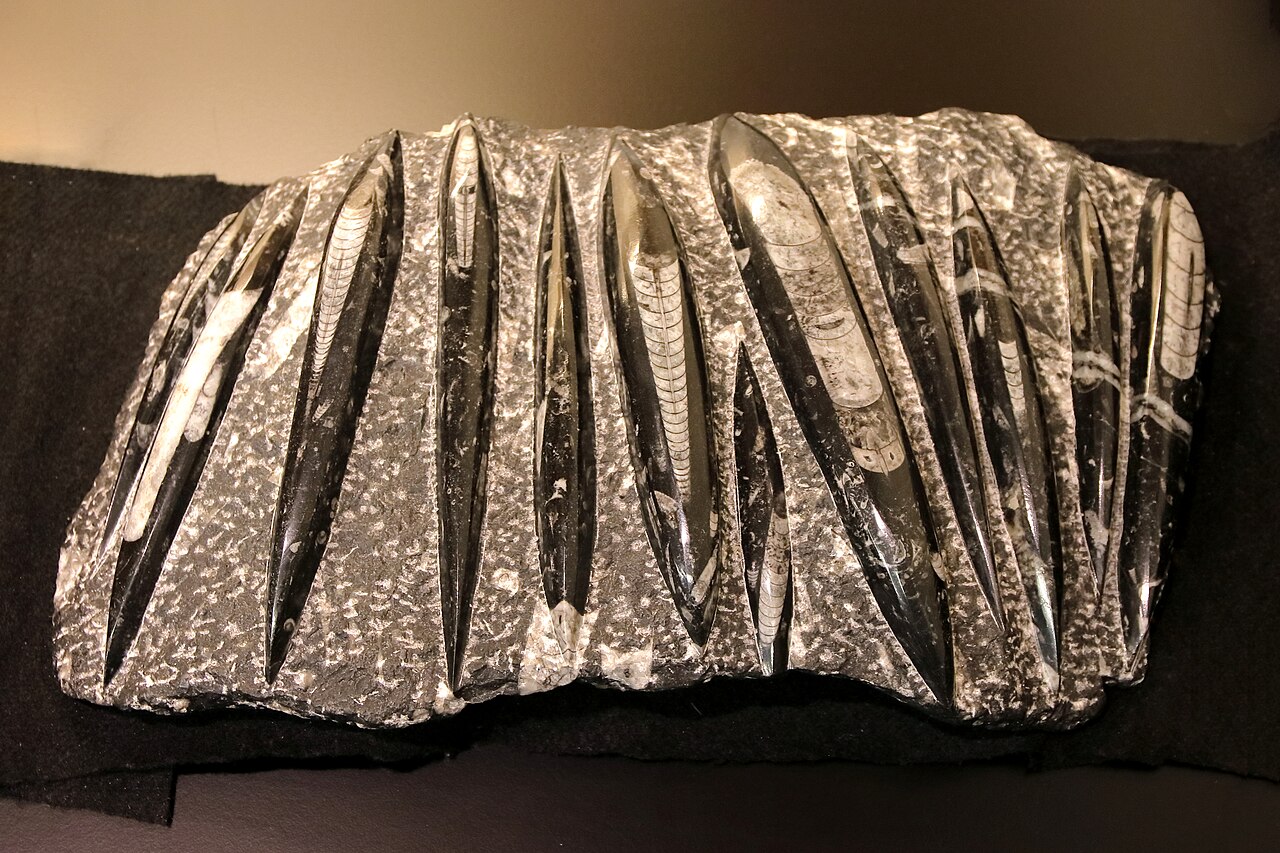
Orthoceras
Orthoceras
CaCO₃ Properties
- Category
- Fossil
Orthoceras is the fossilized shell of an ancient marine cephalopod, composed primarily of calcium carbonate, that lived from the Cambrian to the Permian (approximately 485-252 million years ago). Recognizable by its characteristic conical and elongated shape with internal chambers, it represents one of the most common and fascinating fossils in mineralogical and paleontological collections.
Orthoceras belongs to the class Cephalopoda, marine organisms related to modern squids and octopuses, but with a rigid and segmented external skeleton. The Greek name literally means "straight horn," referring to the typical shape of the shell. These animals were dominant predators in Paleozoic oceans, with specimens that could reach considerable lengths, from a few centimeters to 4-5 meters in the larger genera.
The internal structure of the shell is characterized by buoyancy chambers (siphuncles) that allowed the animal to control its depth in water, a sophisticated mechanism of biological hydrostatics. The fossilized material is composed of aragonite or calcite, both polymorphs of calcium carbonate, often recrystallized during diagenesis. Orthoceras fossils are commonly found in marine sedimentary rocks of the Paleozoic, particularly in calcarenites and marls, and represent excellent stratigraphic markers for relative dating of deposits.
Orthoceras is a fossil cephalopod with a shell (concha) composed of calcium carbonate (CaCO₃) in the form of primary aragonite, frequently diagenetically converted to calcite. The crystal structure of the matrix is trigonal (space group R32/m for calcite; Pmcn for aragonite), with hardness 3-4 on the Mohs scale, consistent with carbonates. The relative density is approximately 2.7-2.95 g/cm³.
Morphologically, the shell presents a circular or slightly compressed cross-section, with an external surface that is smooth or ornamented by longitudinal ribs according to species. The buoyancy chambers are separated by calcareous septa perforated centrally by the siphon, a tubular structure that passes through all chambers. The apical aperture (living chamber) is generally circular, with diameter varying from 5 mm to over 30 mm in macroconchs.
Infrared spectroscopic analysis shows characteristic absorption bands of carbonates (ν₃ at 1450 cm⁻¹, ν₄ at 712 cm⁻¹). The isotopic composition of carbon and oxygen (δ¹³C, δ¹⁸O) provides information on paleotemperature and salinity of the depositional environment. Orthoceras is diagnostic for the Paleozoic (Ordovician-Permian), with maximum diversity in the Silurian and Devonian.
Mining localities
- Marocco (Erfoud, Anti-Atlante)
- Stati Uniti (Ohio, Kentucky, Indiana)
- Canada (Ontario, Manitoba)
- Svezia (Gotland)
- Francia (Ardenne)
- Repubblica Ceca (Boemia)
- Russia (Urali)
- Cina (Yunnan)
Frequently Asked Questions
How do you identify an authentic Orthoceras fossil?
An authentic Orthoceras displays an elongated conical shape with a circular cross-section and internal chambers visible in cross-section. Its composition is primarily calcium carbonate (CaCO₃), and the surface typically shows characteristic longitudinal striations with a smooth appearance and color ranging from white to gray-brown depending on fossilization.
How much does an Orthoceras fossil cost and where can you buy it?
Orthoceras prices vary significantly from €15 to €200+ depending on size, quality, and specimen completeness. They are readily available from mineral and fossil shops, specialized online platforms, mineral fairs, and museums selling educational collections; rarer and well-preserved specimens are found through specialized collectors and auction houses.
What geological period did Orthoceras live in?
Orthoceras lived from the Cambrian to the Permian period, spanning approximately 233 million years (485-252 million years ago), dominating Paleozoic oceans as predatory cephalopods. Their extinction occurred during the Permian-Triassic mass extinction event, the most catastrophic extinction episode in Earth's history.
How did Orthoceras fossils form and what information do they provide?
Orthoceras fossilized when the calcareous shells of ancient cephalopods were covered by marine sediments that gradually compacted and mineralized, preserving the internal chamber structure. These fossils provide crucial information about Paleozoic marine biodiversity, cephalopod evolution, and ancient ocean conditions, serving as important stratigraphic markers for dating sedimentary rocks.
Entry generated with Claude API (Anthropic) on data extracted from Mindat, RRUFF and Wikipedia. Not yet reviewed by a human expert. Verify data against original sources before citing in formal work.