Crinoid
Crinoide
CaCO₃ + MgCO₃ Properties
- Category
- Fossil
Crinoids are fossil marine echinoderms, ancient relatives of starfish, whose calcareous skeleton formed by articulated ossicles is exceptionally preserved in sediments as fragments or rarely as complete specimens. Composed primarily of magnesian calcite, they represent some of the most abundant and fascinating fossils from the Paleozoic to the present day.
Crinoids are sessile or pseudo-planktonic echinoderms that dominated Paleozoic oceans, reaching maximum diversity in the Carboniferous. Their body consists of a cup (calyx) anchored to an articulated stem fixed to the seafloor, with filtering arms that captured plankton. The skeleton is entirely composed of magnesian calcite (CaCO₃ + MgCO₃), crystallized in the trigonal system, with hardness 3–4 on the Mohs scale—sufficient for preservation in sediments but fragile to handling.
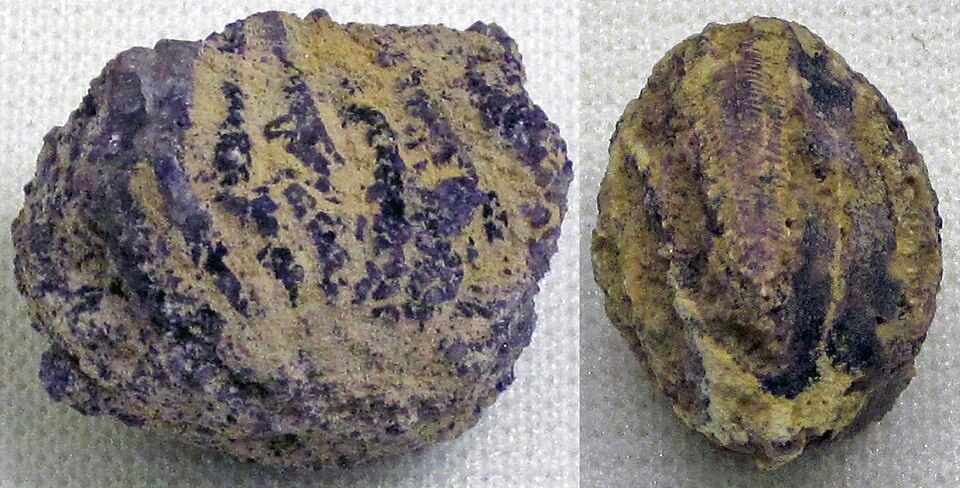
Crinoid ossicles, the individual disc-shaped elements of the stem, are among the most common fossils in marine sedimentary rocks, sometimes so abundant as to constitute entire crinoidites (calcarenites rich in crinoid fragments). Their morphology varies enormously among genera: some exhibit smooth, simple stems, others elaborate structures with lateral cirri. Modern crinoids (Articulata) survive in present-day oceans, while their Paleozoic ancestors (Camerata, Inadunata) went extinct in the Permian. From a paleontological perspective, crinoids are extraordinary environmental and chronological indicators, enabling stratigraphic correlation of sedimentary sequences.
Fossil crinoids present a magnesian calcite skeleton with variable composition CaCO₃ + MgCO₃ (MgCO₃ content generally 5–15 mol%). Crystal system: trigonal, space group R3c (calcite). Mohs hardness: 3–4, lower than pure calcite due to magnesium substitution. Density: 2.71–2.73 g/cm³. Ossicles exhibit undulatory extinction under optical microscopy in polarized light, reflecting their monocrystalline nature with specific crystallographic orientation. Chemical composition determinable via X-ray fluorescence spectrometry (XRF) and X-ray diffractometry (XRD); Mg/Ca ratios vary with depositional environment (cold waters = lower Mg). Carbon and oxygen isotopic analysis (δ¹³C, δ¹⁸O) provides paleoclimatic and paleoenvironmental information. Ossicles exhibit stereom characteristics (crystalline porous architecture) observable under scanning electron microscopy (SEM). Raman spectroscopy reveals characteristic calcite bands at ~1086 cm⁻¹ (C–O stretching) and ~712 cm⁻¹ (C–O bending). UV fluorescence generally weak or absent.
Mining localities
- Marocco (Erfoud, Merzouga) — crinoiditi del Devoniano
- Francia (Normandia, Borgogna) — crinoiditi del Giurassico
- Germania (Baviera) — crinoiditi del Giurassico superiore
- Indiana, USA — crinoiditi del Carbonifero
- Inghilterra (Somerset, Dorset) — crinoiditi del Giurassico
- Belgio (Mons) — crinoiditi del Carbonifero
- Spagna (Andalusia) — crinoiditi del Triassico
- Giappone (Hokkaido) — crinoiditi del Cretaceo
- Cina (Guizhou, Yunnan) — crinoiditi dell'Ordoviciano-Siluriano
Frequently Asked Questions
How do I identify a crinoid fossil?
A crinoid fossil is recognized by its characteristic articulated calcareous ossicles, small discs or cylinders of calcite (CaCO₃ + MgCO₃) forming the stem, often found isolated or fragmented. Better-preserved specimens also display articulated arms and the calyx, typical structures of these ancient marine echinoderms.
Where can I find crinoid fossils and how much do they cost?
Crinoid fossils are found in marine sedimentary rocks from the Paleozoic and Mesozoic eras, particularly in deposits across the USA, England, and France. Prices vary considerably: common fragments cost €5-20, while complete or rare specimens can reach hundreds of euros in specialized markets.
What were the physical characteristics and habitat of fossil crinoids?
Crinoids were sessile echinoderms with a calcareous skeleton composed of articulated ossicles, equipped with filtering arms to capture food. They inhabited marine seafloors from the Silurian to the Cretaceous, with peak diversity in the Paleozoic, living attached to the substrate and forming vast fossiliferous gardens.
Why do crinoids fossilize so well?
Crinoids fossilize exceptionally well thanks to their calcite skeleton (CaCO₃ + MgCO₃), which resists chemical and biological decomposition. The articulated ossicles frequently preserve as individual elements in quiet marine sediments, and occasionally as complete skeletons when rapidly buried in anoxic environments.
Entry generated with Claude API (Anthropic) on data extracted from Mindat, RRUFF and Wikipedia. Not yet reviewed by a human expert. Verify data against original sources before citing in formal work.